
Sub-Orbital Payload Delivery
Near Space Launch to the Stratosphere and Beyond
Green Launch uses a hydrogen and oxygen light-gas launcher to send your payload into near space. Clean propulsion. Only byproduct is water vapor.
- Vertical launches to the stratosphere and above
- Mesosphere and ionosphere sampling for research teams
- Tested at the U.S. Army Yuma Proving Ground, Arizona
First vertical launch reached the stratosphere above Mach 3 on December 21, 2021.
Prefer to talk? Call 619-933-6678

Tell us about your payload
Send a few details and our team will get back to you about your near space launch.
Why teams choose Green Launch for near space
Reach near space without a rocket
A light-gas launcher pushes your payload to the stratosphere and beyond. No chemical rocket stage needed.
Zero carbon launches
The propellant is hydrogen and oxygen gas. The only byproduct is water vapor.
Low cost access
Low-cost launches are the core of our model, built to open up space access that is limited today.
Proven at a U.S. Army range
Testing runs at Yuma Proving Ground in Arizona under a contract signed in 2017.
Payload bodies built for data
Wound fiberglass bodies are light, strong in compression, and RF transparent so antennas stay protected inside.
Quiet, clean muzzle
Over 91% of the propellant was captured in a demonstration, cutting muzzle flash and acoustic signature.
What a near space launch with us looks like
Green Launch sends payloads into near space with a light-gas launcher instead of a rocket. Hydrogen and oxygen gas are combusted in a chamber and drive the vehicle up the launch tube. On December 21, 2021, our first vertical attempt put a projectile into the stratosphere from a 54 foot tube at a velocity above Mach 3.
Sub-orbital payloads and atmospheric sampling are a strong focus for us, with launch series run at Yuma Proving Ground in Arizona. These low-cost launches also lay the foundation for the Green Express launcher, which is being developed to carry satellites and supplies to Low Earth Orbit.
- Vertical light-gas launches to the stratosphere and beyond
- Atmospheric sampling of the mesosphere for climatology data
- Ionosphere access for communication, navigation and surveillance R&D
- 54 foot vertical launch tube; 7-inch x 55-foot tube used in horizontal testing
- Projectile velocities up to 2.97 km/sec (Mach 9) demonstrated
- Hypersonic and scramjet flight testing, including nine scramjets flown with SHARP
- RF-transparent wound fiberglass vehicle bodies that protect internal antennas
- Propellant capture of over 91% demonstrated under contract
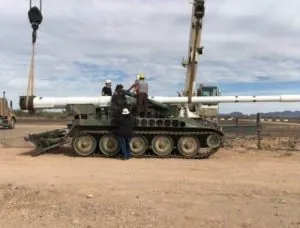
Test record and capability
“Green Launch is currently exploring the velocity maximum of a one stage light-gas combustion system. With a combustion chamber containing light-gas fuel, oxidizer and multiple igniters, launch projectile velocities of 2.97 km/sec (Mach 9) have been achieved.”
“Green Launch has demonstrated one of the most significant advancements in the efficiency and sustainability of launch technology. As part of a demonstration contract, Green Launch has captured over 91% of the propellant for a light-gas launcher.”
What happens after you send your details
We review your mission
Tell us the payload, target altitude and what data you need. Our team reads it and checks the fit.
We talk through the technical plan
Dr. John W. Hunter and the team discuss vehicle design, velocity and the launch profile with you.
We scope the program
We outline a test or launch series at Yuma Proving Ground and send you a proposal.
Frequently asked questions
How high can you launch a payload?
Our first vertical attempt on December 21, 2021 reached the stratosphere at a velocity above Mach 3. We also design vehicles for sampling the mesosphere and ionosphere. Your target altitude is set during scoping.
Where do launches take place?
Launch and test operations are conducted at the U.S. Army's Yuma Proving Ground in Arizona. We serve customers across the United States.
What does a near space launch cost?
Pricing depends on the payload, target altitude and the number of shots in the series. For orbital delivery, our stated target is $100 per pound. Send your mission details and we will scope it for you.
Is this really a rocket launch?
No. We use a light-gas launcher, sometimes called a hydrogen cannon. Hydrogen and oxygen gas drive the vehicle up the launch tube, and the only byproduct is water vapor.
Can my instruments transmit from inside the vehicle?
Yes. The vehicle body uses wound fiberglass that is transparent to RF, so the antenna can be protected inside the vehicle.
Who do you work with?
We work with defense and aerospace organizations, satellite companies, universities and scientific research groups. The National Science Foundation was a near term customer for mesosphere sampling.
Ready to put your payload in near space?
Tell us your payload, altitude and timing. Our team will review the mission and follow up with next steps.
- Vertical launches to the stratosphere and above
- Mesosphere and ionosphere sampling for research teams
- Tested at the U.S. Army Yuma Proving Ground, Arizona
Prefer to talk? Call 619-933-6678